 When families begin thinking about life after high school, the conversation often starts with one question: What’s next?
For some, the answer feels obvious. For others, it feels overwhelming. Choice can feel like a double-edged sword — “I get to choose” and “How will we possibly decide?” — all at the same time.
The truth is, higher education is no longer a single path. And sometimes, the path needs to pause and be reevaluated along the way. Today, college options for neurodivergent students are more expansive than ever before. Four-year universities, community colleges, technical programs, and online institutions all offer meaningful opportunities.
The key is not choosing the “right” path. It’s choosing the path that fits where a student is today — academically, socially, and in terms of independence.
At CLE, we believe there are many right answers. Our role is to walk alongside students and families as they explore those answers and build a plan that supports long-term independence, education, and career growth.
Higher Education: More Than One Road
 Higher education includes both four-year universities and community colleges — and both deserve equal consideration.
For years, a bachelor’s degree was viewed as the primary goal. Today, we know success looks different for every student. What matters most is alignment: academic fit, level of support, college readiness for autistic students, and the ability to step into independent routines.
When students choose a path that matches their strengths and learning style, confidence grows. And confidence drives success.
Community Colleges
 Community colleges are often one of the most strategic and underappreciated college options for neurodivergent students.
They offer smaller class sizes, lower tuition, flexible scheduling, and a more gradual transition into postsecondary learning. For many students, this environment creates space to strengthen executive functioning skills, manage a reduced courseload, and better understand academic expectations before transferring to a four-year institution.
Research continues to show that community college is not a detour — it is a strategic pathway. At CLE, we see students work toward certificates or associate degrees and, in many cases, transfer to nearby universities with continued structure and support. For some, that stepwise transition to college for neurodivergent students makes all the difference.
Four-Year Colleges and Universities
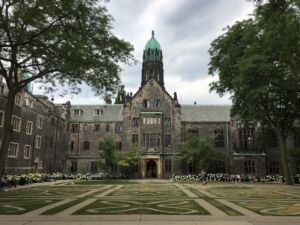 Four-year institutions offer expansive academic programs, campus life, research opportunities, and structured degree pathways. For many students, this environment provides the intellectual rigor and social experience they are seeking.
At the same time, the transition to college for neurodivergent students can feel significant. Shifting into the role of primary manager of one’s learning — organizing long-term assignments, navigating syllabi, advocating with professors — requires strong executive functioning.
Many CLE students attending four-year universities benefit from executive functioning support in college, including coaching in time management, planning, self-advocacy, and managing larger academic workloads. We are located near universities with strong accessibility offices and established histories of working with CLE students, allowing for layered support.
Another important consideration is housing. Dorm living works well for some students and feels overwhelming for others. Exploring alternatives, such as apartment-style living with structured support, can make a meaningful difference in a student’s independence and overall experience.
Technical and Vocational Schools
 For students drawn to hands-on learning and clearly defined career paths, technical and vocational programs can be an excellent fit.
These programs emphasize practical skills and workforce readiness in fields such as healthcare, information technology, culinary arts, and the skilled trades. The structured, applied nature of this education often appeals to students who thrive with clear expectations and tangible outcomes.
A direct path into a profession is not a lesser path — it is an intentional one. In some cases, it may reduce the stress of pursuing a traditional degree when one is not required for the career a student is seeking.
CLE students have pursued technical programs aligned with their interests and values, including Veterinary Assistant, Emergency Medical Technician, HVAC Technician, Automotive Certifications, and Microsoft Office Specialist credentials. These pathways often provide more immediate employability while supporting long-term career development.
Choosing the Right Fit
 Exploring post-high school options can feel daunting. There are financial considerations, questions about readiness, and the weight of making the “right” choice.
But it is also an exciting moment. Students today have more options than ever before.
The goal is not to fit into a predefined mold. It is to identify an environment where a student can grow academically, socially, and personally — while building the independence needed for adult life.
At CLE, we support students across the full landscape of college options for neurodivergent students — from community colleges and four-year universities to technical programs and online coursework. Our focus remains consistent: strengthening college readiness, providing executive functioning support in college, and preparing students for meaningful, self-directed futures.
With the right preparation and the right support, each of these paths can lead to a confident transition into adulthood.